Active Authentication for Mixed Reality via Behavioral Biometrics

Hand Kinematics • Eye Movement • Head Pose

This research line investigates active authentication for mixed reality using behavioral biometrics. MR systems are inherently shared, since multiple users may access the same device; intermittent, with users frequently starting and stopping sessions; and immersive, relying on continuous 3D interaction rather than conventional input methods. Together, these properties challenge the effectiveness and usability of traditional authentication mechanisms. Typing on a virtual keyboard breaks presence and is shoulder-surfable by anyone in the room; one-shot face or iris checks tell you who unlocked the device, not who is wearing it now, or whether the person reaching for a sensitive action is the one who originally signed in. Active authentication is the broader response: verifying identity from signals the user naturally produces while using the system — whether at session entry, continuously throughout the session, or at security-sensitive moments such as payments and admin actions.

We treat behavioral signals produced by ordinary in-headset use as biometric sources: hand and controller kinematics, eye-movement dynamics, and head-pose trajectories. The lab's contribution is not any single modality but a coherent research paradigm that focuses on domain-informed models, cross-session evaluation protocols across days and months, and compact architectures that can fit inside a mobile XR device's compute budget, aimed at making active authentication something MR platforms could actually deploy.

The section below describes how we approach the problem; a list of publications at the bottom of the page points to the individual studies that make up this research line.

How we approach it

01 — Modalities

In-headset behavior as a biometric source

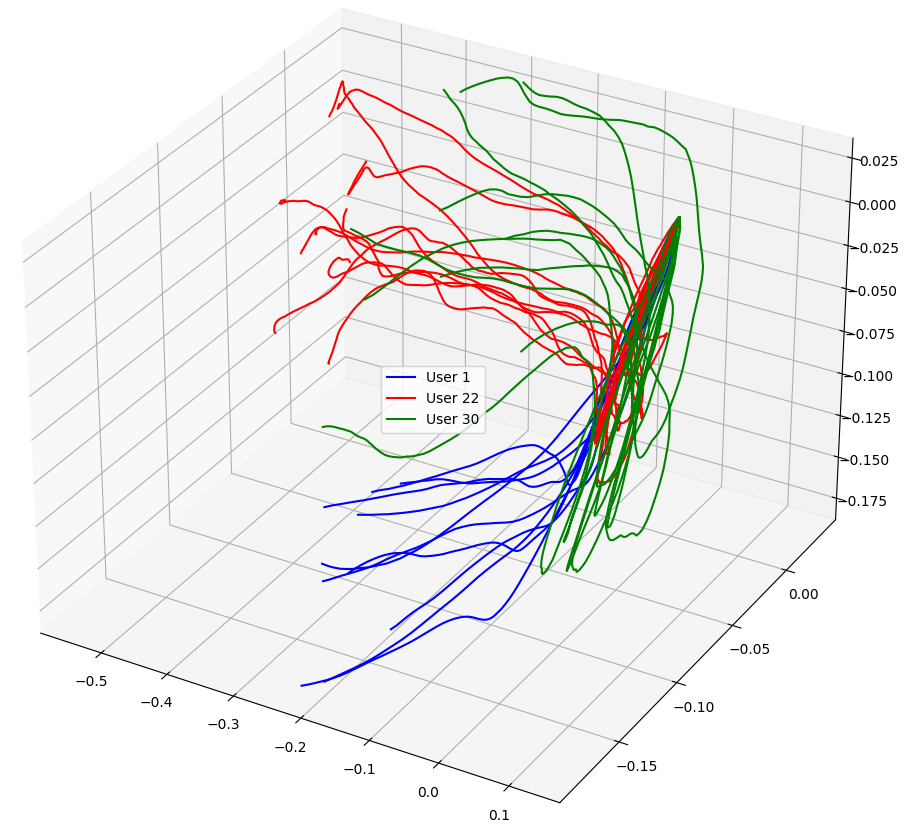
Rather than committing to a single sensor, we study a set of behavioral signals produced by ordinary MR use. Hand and controller kinematics capture individual differences in how a user types, reaches, grips, and pulls — signatures shaped by anthropometry and motor habit. Eye-movement dynamics expose individual oculomotor patterns through saccades, fixations, smooth pursuits, and scan paths. Head-pose trajectories from the headset's own 6-DoF tracking reveal habitual postural micro-patterns during natural visual exploration.

Each modality maps naturally onto a different active-authentication moment: typing-time hand traces for entry-point gating, gaze and head dynamics for continuous in-session verification, and any of them for step-up checks before sensitive actions. The combination, not any single channel, is what makes a deployable XR authentication stack.
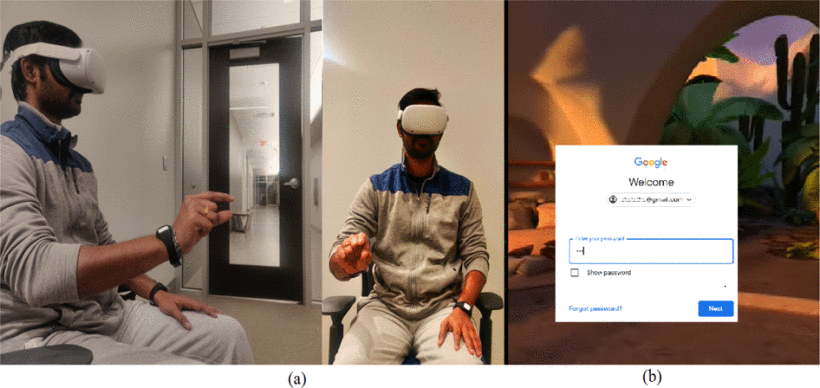
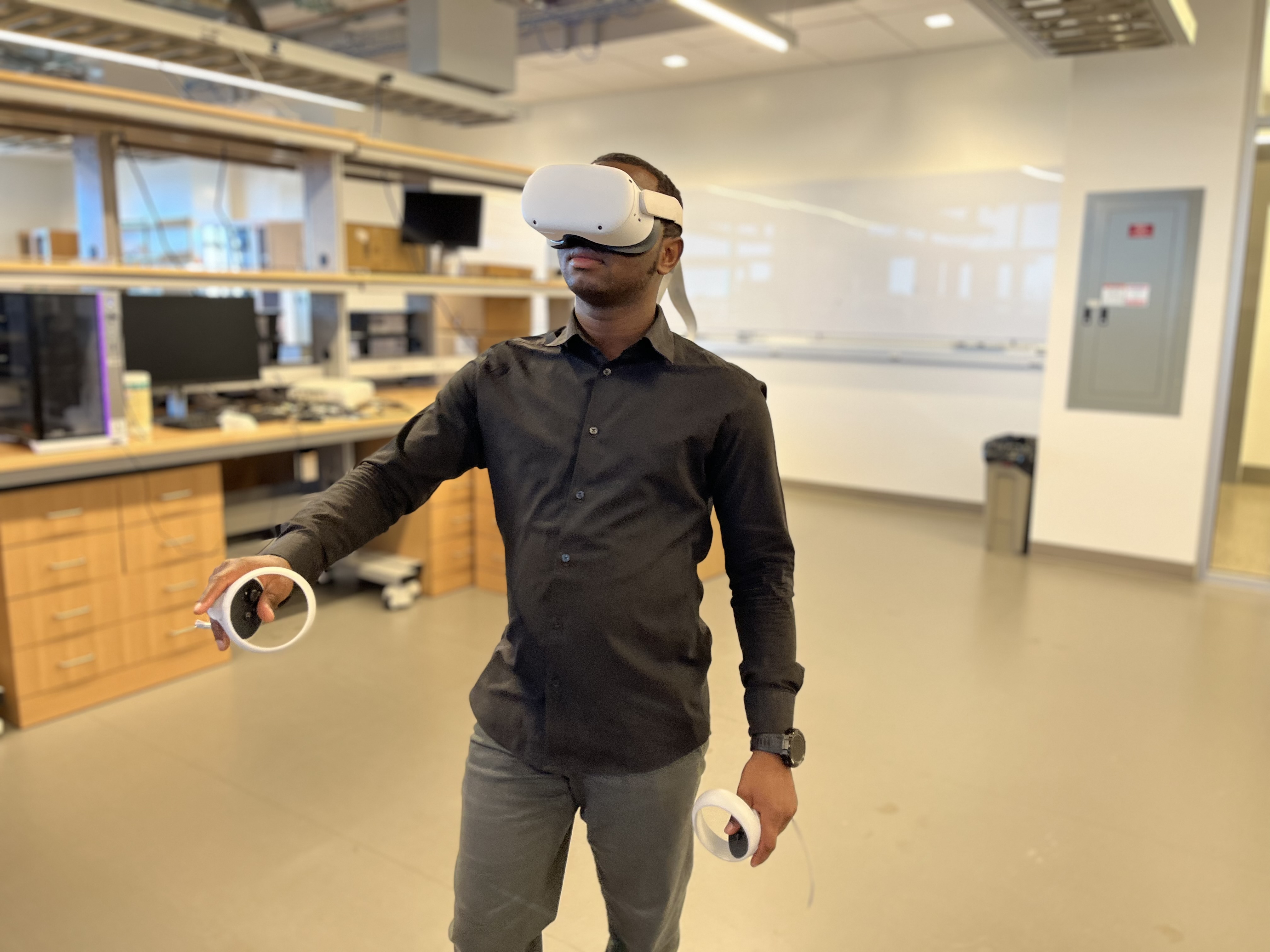
Three behavioral signals captured by ordinary in-headset use. Each carries individual signatures stable enough to support active authentication; together they cover the entry, continuous, and step-up moments of an MR session.
02 — Methodology

Domain-informed models and cross-session evaluation

Behavioral signals in MR are not generic time series. Eye movements obey characterized oculomotor physiology; head pose is constrained by neck biomechanics; hand kinematics by motor habit. Our modeling work foregrounds that domain structure rather than discarding it — specialized feature-extraction modules built around oculomotor event classes for eye-movement biometrics, task-specific extractors for head and hand streams, and similarity-learning architectures (Siamese networks) for verifying typing-time hand traces.

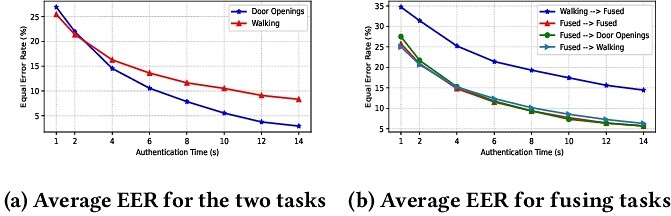
Evaluation is held to a higher bar than the field's usual within-session classification, which tends to overstate what a deployed system would achieve. We use cross-session protocols across days and weeks, and longitudinal analyses reaching into the multi-month range — including a 269-day window for controller-based door-opening behavior and a 37-month slice of the GazeBase eye-movement corpus. The recurring methodological question is feature temporal stability: which signatures actually remain individuating as the user's biology and habits drift?
03 — Deployment

Architectures and protocols a headset can actually run

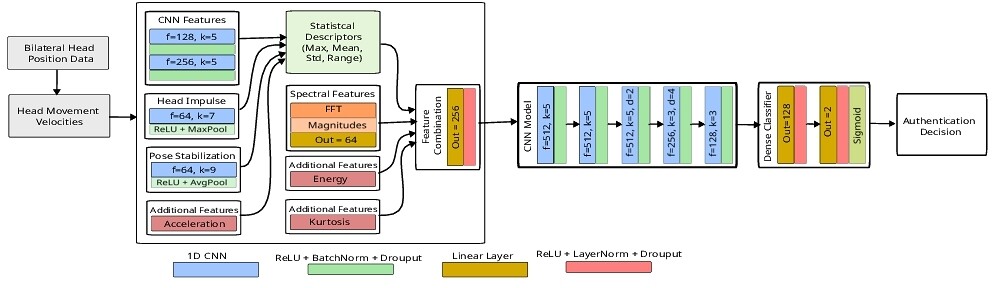
Active authentication has to live inside a mobile XR device's compute budget. We favor compact architectures over heavy sequence models: a small feed-forward 1D CNN on head pose, a parameter-efficient design for eye-movement biometrics that matches state-of-the-art accuracy with fewer parameters, and a Siamese-similarity model for hand typing that operates at practical FAR/FRR points. None of these requires workstation-class inference.

We also study practical deployment questions that get little attention but matter for shipping: how many enrollment tasks are needed before adding more stops paying off? How does authentication accuracy degrade across months, and is the curve linear or non-linear? Which task subsets generalize best to unseen activities? The output we want is not just a low EER on a paper, but guidelines that XR vendors could actually use to integrate behavioral biometrics into a real product.

Three behavioral signals captured by ordinary in-headset use. Each carries individual signatures stable enough to support active authentication; together they cover the entry, continuous, and step-up moments of an MR session.

Publications

The papers below report the individual studies that make up this research line. Each links to the full text where available.

2025
IEEE WIFS
DIEMB: Domain-Informed Eye Movement Biometrics
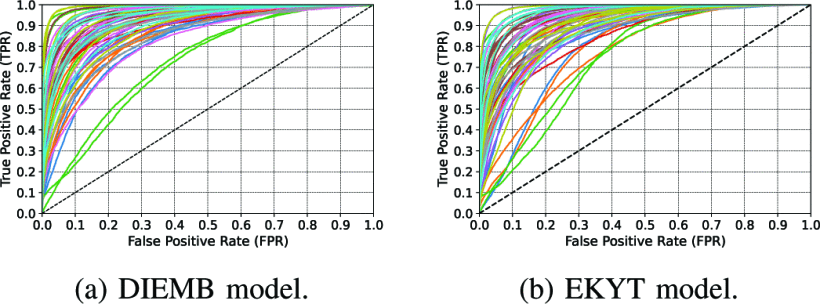
Specialized feature-extraction modules built around oculomotor event classes — saccades, fixations, smooth pursuits, and scan paths. On a 37-month longitudinal slice of GazeBase, DIEMB matches the state-of-the-art EKYT at the user level (15.2% vs. 16.2% average EER) using 6% fewer parameters, and identifies 2–3 structured tasks as sufficient to match full-task enrollment performance.
2025
ACM VRST
Head Movement Biometrics for Continuous Authentication in Virtual Reality
A compact 1D CNN over windowed 6-DoF head-pose streams with task-specific extractors, designed to fit a headset's compute budget. The model reaches a best 2.9% EER, competitive with much heavier sequence baselines, supporting head movement as a viable continuous-authentication signal alongside gaze and gesture.
2024
IEEE FG
HM-Auth: Hand-Movement Biometrics for VR Text Entry
A Siamese-network similarity model over hand-controller trajectories produced while a user types a predefined phrase on a VR keyboard. Across 30 participants, a symmetric-rejection method achieves a False Acceptance Rate of 0.08 at a False Reject Rate of 0 — positioning HM-Auth as a practical entry-point or step-up authentication option for immersive VR.
2026
Anon
Under review
VR-Gate: Door-Opening Behavior as a Longitudinal VR Biometric
A 45-participant longitudinal study spanning sessions up to 269 days, capturing head pose and hand kinematics during door-opening tasks. Per-user classifiers are evaluated under increasingly large temporal gaps; the door-opening signature remains discriminative across substantial inter-session drift, supporting use as a low-friction continuous VR biometric.