Brain Signal–driven User Authentication and Human-Machine Interactions
Research Overview
Electroencephalography (EEG) offers a unique window into human cognition, capturing rapid neural responses that are difficult to observe or replicate externally. These properties make EEG an intriguing candidate for next-generation user authentication systems, particularly as traditional methods (such as passwords, fingerprints, and facial recognition) remain vulnerable to theft, spoofing, and deepfake manipulation.
Our work focuses on developing robust EEG-based user authentication pipelines using:
- Cognitive and perceptual ERPs (P300, N400, familiarity response)
- Memory-driven tasks for high-security verification
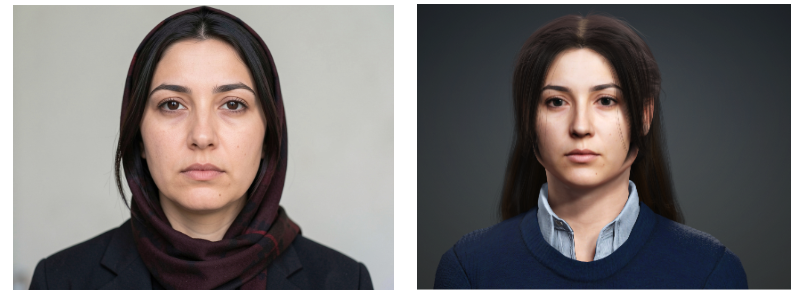
- Uncanny valley stimuli and face recognition in VR/AR
- Multi-session authentication (cross-day generalization)
- Secure and attack-averse machine learning models
We aim to design authentication systems that remain reliable across days and sessions, operate seamlessly in VR/AR, and maintain user privacy without revealing personal behavioral traits.
This project is supported by the National Science Foundation (NSF) under Award No. 2340997, CAREER: BrainCAPTCHA: Completely Automated Test for User Verification using Dynamic Brain Biometrics.
Ongoaing Research
Cognitive & Memory-Driven EEG-Based User Authentication

- Color Congruency Task (Stroop Task): Users viewed color words printed in matching or mismatching ink colors, producing attention-driven ERPs such as the P300.
- Memory Recognition Task: Users memorized a set of words, then identified repeated vs. new words. This task elicited robust N400 and late positive components, producing the most distinctive neural signatures.
ERP-Based User Authentication Using Ensemble Learning
EEG-Based User Authentication Using Face Familiarity in VR
Related Publications
- Cognitive and Memory-Driven EEG-Based Authentication: A Multi-Session Approach to Secure Biometric Systems
- Soudabeh Bolouri, Diksha Shukla,
- 2025 IEEE 19th International Conference on Automatic Face and Gesture Recognition (FG), May 2025
- An EEG-Based User Authentication System Using Event-Related Potentials and Ensemble Learning
- Soudabeh Bolouri, Diksha Shukla,
- IEEE 4th Cyber Awareness and Research Symposium 2024 (CARS'24), October 2024
- Concealable Biometric-based Continuous User Authentication System An EEG Induced Deep Learning Model
- Sindhu Reddy Kalathur Gopal, Diksha Shukla,
- IEEE International Joint Conference on Biometrics (IJCB), August 2021
- Thinking Unveiled: An Inference and Correlation Model to Attack EEG Biometrics
- Diksha Shukla, Partha Pratim Kundu, Ravichandra Malapati, Sujit Poudel, Zhanpeng Jin, Vir Phoha,
- ACM Digital Threats: Research and Practice, May 2020
- Brain Signals and the Corresponding Hand Movement Signals Dataset (BS-HMS-Dataset)
- Diksha Shukla, Sicong Chen, Yao Lu, Partha Pratim Kundu, Ravichandra Malapati, Sujit Poudel, Zhanpeng Jin, Vir Phoha,
- IEEE Dataport, October 2019